Our History

The Bayview Hunters Point Foundation for Community Improvement, Inc. (BVHPFCI) was established by citizens of the Bayview Hunters Point district to serve the residents of its community.
BVHP Foundation’s Evolution:
1970s
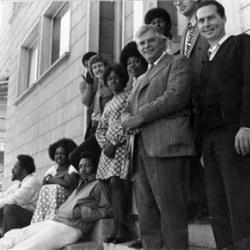
- Ernest Mitchell Jr, a life long resident of the Bayview District formed the Foundation in 1971 to to address the problems of crime and drug abuse in the neighborhood. He was the Founder and Executive Director.
- The Community Defender Program was launched with an initial staff of 9.
The Community Defender Program, the first of its kind, addressed the full range of client problems to ensure that Bayview residents were not disproportionally pushed into the criminal justice system, the program advocated that everyone should go to trial. - To adapt to changing times, the Foundation created the Drug Therapy Program to combat crime-related drug abuse, then later launched Methadone Maintenance clinic, and Anti-Drug programs for youth.
- By 1975, the Foundation launched a program called Center for Problem Drinkers to deal with offered individual and group counseling for alcohol abusers and their spouses in addition to alternative activities that provided for multiple coping mechanisms.
- The Foundation created a Youth Program to help steer Bayview youth into the legal profession. The agency later modified the Youth Program to include substance abuse day program for teens.
1980s
- By 1980, the Foundation had expanded to deliver outpatient mental health and substance abuse day program in the Tenderloin District.
- With the introduction to HIV/AIDS epidemic, the Foundation started the Black Coalition on AIDS. And they led the Southeast sector of the city in providing outreach, treatment, and research on AIDS.
- The Foundation received state licensing in 1983 for their Methadone Maintenance program to address the 1980’s wave of crack addiction.
- The Foundation launched TRAID Acupuncture Clinic to study acupuncture as a detoxification method for heroin and crack cocaine, where the agency submitted their findings to the City Health Commission and major medical journals.
- The Foundation also administered a Rehabilitation Community Center on 16th Street that included day treatment and psychosocial rehabilitation. The Center targeted adults in the Mission neighborhood and Southeast Districts of San Francisco.
- The Foundation’s Youth Services Program developed into serving at-risk youth and participated in juvenile court hearings, probation visits, peer counseling program, tutoring, and other educational programs. They also started a prevention program with “latch-key” children (ages 4-11 years).
- Mr. Mitchell passed away in October 1984, with 85 employees, and budget of a little over $2 million.
- The Board appointed the director of the legal program, Flynn Bradley as Interim Executive Director.
- In early 1985, the Board appointed Shirley Anne Gross as Executive Director. She quickly grew the Foundation to 180 employees with a budget of $3,490,000.
1990s
- In 1992 the Board appointed Austin Thompson as Executive Director but his tenure was relatively short-lived due to conflicts with the agency direction.
- Finally, the Board appointed the agency’s Mental Health Services Director, Karen Patterson Matthew as Executive Director.
- When the Foundation was criticized for its lack of gay services, they set up a Gay and Bi-Sexual Task Force to review and expand their services.
- The Youth Services grew to include the Gang Prevention Project (to deter youth from gang activity by establishing basketball teams for low-income youth who resided in the housing projects). Plus the Foundation became fiscal agent to the Balboa Teen Health Clinic (to reduce high-risk behavior in an urban high school population by linking students to services)
- In the mid-1990 after numerous budget cutbacks, the Foundation could no longer continue its partnership with the Tenderloin District.
- The Foundation joined forces with a non-partisan coalition to increase the political power in the Southeast community, called Building Visions for Healthy Partnerships that included other African-American organizations.
- The Foundation launched Save Our Sisters that focused on women’s health promotion activities related to the prevention of HIV infection.
- The Foundation created Violence Against Women Everywhere to educate the youth about domestic violence prevention.
- The Foundation became fiscal agent to the Third Street Youth Services to focus on the prevention and early detection of mental illness with a focus on diagnosis, treatment, and rehabilitation of children, adolescents and adults with mental and emotional disorders.
- The Foundation launched the Bayview Club-House that provided comprehensive day treatment and vocational services for mentally disturbed adults and vocational rehabilitation.
- The Foundation launched the Healthcare for the Homeless Project to provide medical and psychological services to people who were homeless.
- Major dissension rocked the agency in 1996 when the Service Employees International Union (SEIU- Local 790 AFL-CIO) launched its San Francisco unionization efforts, it focused on organizations with budgets of $5 million or more and the Foundation was one of the first organizations targeted. However the Foundation overcame those challenges.
- In the late 1990s, The Foundation launched the Foster Parent Mentor Training Project to address the need for foster care education, support, and advocacy.
2000s to the Present
- By late 2001, the Foundation contracted with outside consultants to develop a strategic plan that clarified its mission and plan for the future of the agency; thus the agency revised its mission statement and streamlined its strategic plan (2003-2006) to four primary areas of service: mental health, substance abuse, youth, and legal services.
- Karen Patterson Matthew resigned in 2005 after serving 11 years as the “face” of the Foundation. So the Board appointed Deputy Director, Lillian Kim Shine as Interim Executive Director.
- In late 2005 the Board appointed Jacob Moody as Executive Director. His leadership emphasized that the agency’s values should drive the organization and not the contracts, because the service contracts were tools to accomplish the agency goals.
- The Foundation began the process of implementing a county health department initiative in 2005 called the Comprehensive Continuous Integrated System of Care (CCISC) to treat individuals with co-occurring disorders. Example of co-occurring: a patient with a substance abuse problem can also receive mental health treatment and vice versa.
- Presently as with most nonprofits, maintaining continuous funding is a major challenge. The majority of the Foundation’s funding coming from local and state government, locating other funding sources to sustain and develop services is an ongoing concern.
The Foundation continues to be at the forefront to fill identified gaps in the public health system. The agency remains a strong service provider for the underserved areas where over 21% of the residents live below the poverty line (2007 demographic records). While the agency’s primary service area is still the Bayview Hunters Point District, the Foundation’s services are also delivered via partnerships to other San Francisco neighborhoods.